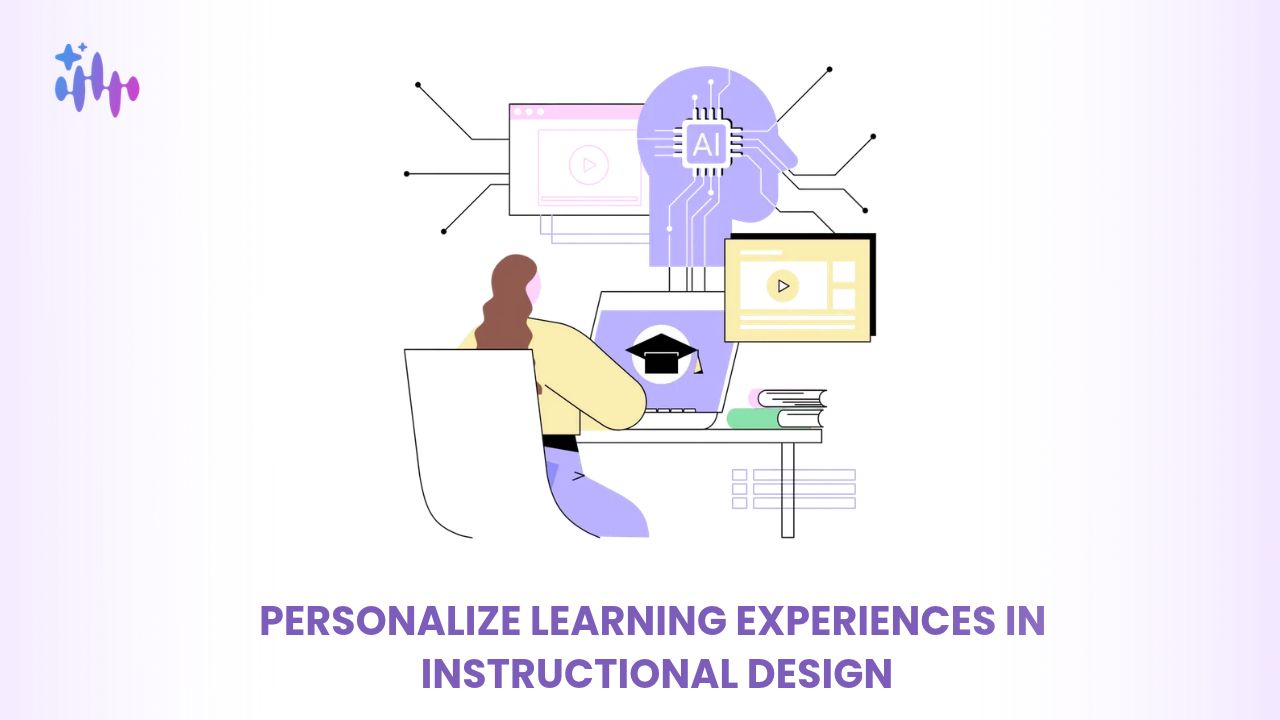
Yes, AI can help personalize learning experiences in instructional design. With AI-powered course creation grounded in approved material, teams can adapt practice, feedback, and support to each learner. AI personalization works well for pacing, questions, and assessment, and poorly without human review of accuracy and context.
Key Takeaways:
- A 2025 randomized trial of 194 Harvard physics students found that a purpose-built AI tutor produced significantly more learning in less time than in-class active learning.
- Design decides the outcome. A 2025 PNAS field experiment with nearly 1,000 high school students found that unguarded GPT-4 tutoring improved practice scores but reduced skill acquisition once AI access was removed. Teacher-designed hints reduced that harm.
- 71% of L&D professionals were exploring, experimenting with, or integrating AI in LinkedIn’s 2025 Workplace Learning Report.
- The main risks are fabricated specifics, outdated information, and missing organizational context. Each requires a human approval step.
How Does AI Personalize Learning in Instructional Design?
AI personalizes learning by using learner responses, questions, and progress signals to adjust practice, feedback, support, and delivery format. Instructional designers still set the objectives and approve the content. Four levers matter most:
- Pacing and sequencing. Quiz results show where a learner is struggling. Vocaliv’s Adaptive Assessment lets teams place chapter quizzes and a final quiz, choose a focus (recall, application, or scenario-based reasoning), and set Easy, Medium, or Hard difficulty.
- Practice and feedback. Generative AI can draft questions from source documents so designers spend their time reviewing them instead of writing them.
- On-demand support. An AI coach can answer questions from approved course material at the moment a learner is confused. Vocaliv states that its AI Coach handles 70%+ of routine trainee questions. That figure is Vocaliv’s own claim, not an independent benchmark.
- Delivery format and voice. Vocaliv’s course builder lets teams deliver a course as text, voice-guided coaching, or a mix. The AI Coach can use a cloned trainer voice or an AI-generated voice.
What Does the Evidence Say About AI-Personalized Learning?
The evidence shows that AI personalization can work, but only when the tool is designed around learning. The Harvard tutor in the Scientific Reports trial followed the same pedagogical practices as the in-class lesson it was compared against.
The PNAS study found the opposite for a generic chatbot. Students used it as a “crutch” during practice and did worse afterward. A tutor that gave hints instead of answers reduced that effect.
For instructional designers, the takeaway is that a personalized experience needs pedagogical structure. Access to a language model alone does not provide it.
What Can AI Personalize, and What Still Needs a Human?
| Design element | What AI can personalize | What a human designer still owns |
| Pacing and sequence | Adjust review and practice based on quiz results | Learning objectives and prerequisites |
| Practice and assessment | Generate questions by topic, count, and difficulty | Checking question quality and fairness |
| Feedback and support | Answer routine questions at any hour | Judgment calls and regulatory interpretation |
| Format and voice | Text, voice-guided, or mixed delivery | Tone, brand, and cultural fit |
| Content accuracy | Draft structure from source documents | Approval before learners see anything |
What Are the Limitations of AI Personalization?
AI personalization has four main limitations:
- Accuracy. Generative AI can invent statistics, cite outdated rules, or present generic best practice as a company’s own procedure. Vocaliv’s guide to AI training content accuracy and hallucination safeguards covers these failure modes and the safeguards that reduce them.
- Over-reliance. Learners who lean on AI for answers can perform well in practice and poorly later, as the PNAS study showed.
- Thin data. A small cohort produces few signals, so AI personalization built on learner behavior is weaker for small training teams.
- Context. AI does not know a client’s internal policies unless the source material contains them.
Compliance, health and safety, and certification-bearing programs carry the highest cost of error. They need the strictest review.
For training teams facing these trade-offs, Vocaliv’s AI Coach delivers course content from approved material and lets teams set when it answers and when a trainer steps in.
What Are Best Practices for Personalizing Learning With AI?
- Ground AI in your own material. Generating from uploaded manuals, PDFs, and SOPs leaves less room for invention than open-ended prompting.
- Keep a qualified reviewer in the approval path. A human should approve content before learners access it.
- Design for productive struggle. Prefer hints, checks for understanding, and scenario questions over tools that hand out answers.
- Define escalation rules in advance. Decide which question types the AI must hand to a trainer.
- Measure at chapter level. Track where learners stall instead of relying on a final pass or fail. Vocaliv’s analysis of whether AI coaching actually works covers where the evidence is strong and where it is not.
- Start with one program. Pilot on a single course, review the results, then expand.
How Does Vocaliv Fit?
Vocaliv is an AI operational layer for training delivery and learning automation, not a traditional LMS. Its course builder turns uploaded training materials into a structured course with modules, lessons, objectives, and quizzes that a trainer reviews and edits. The AI Coach then supports trainees from that approved content. The goal is to let a training team serve more learners without adding trainer hours in proportion.
FAQs
No. AI can draft structures, questions, and support responses, but designers set learning objectives, judge quality, and approve content. The research above shows outcomes depend on how the AI tool is designed and supervised.
It can be effective when built on sound pedagogy. A randomized Harvard trial found stronger learning from a well-designed AI tutor, while a separate PNAS study found harm from an unguarded chatbot.
It is usable with safeguards. Ground generation in approved policies, require qualified human sign-off before release, and configure the AI to escalate regulatory questions instead of answering them.
Yes. Uploading existing materials, generating draft quizzes, and using an AI coach for routine questions gives small teams personalization features without a dedicated instructional design department.
Final Takeaway
AI can personalize pacing, practice, feedback, and support in instructional design. Human designers still need to own the objectives, the accuracy, and the judgment calls. Teams that combine both get the benefits of personalization without the risks of unguarded AI.