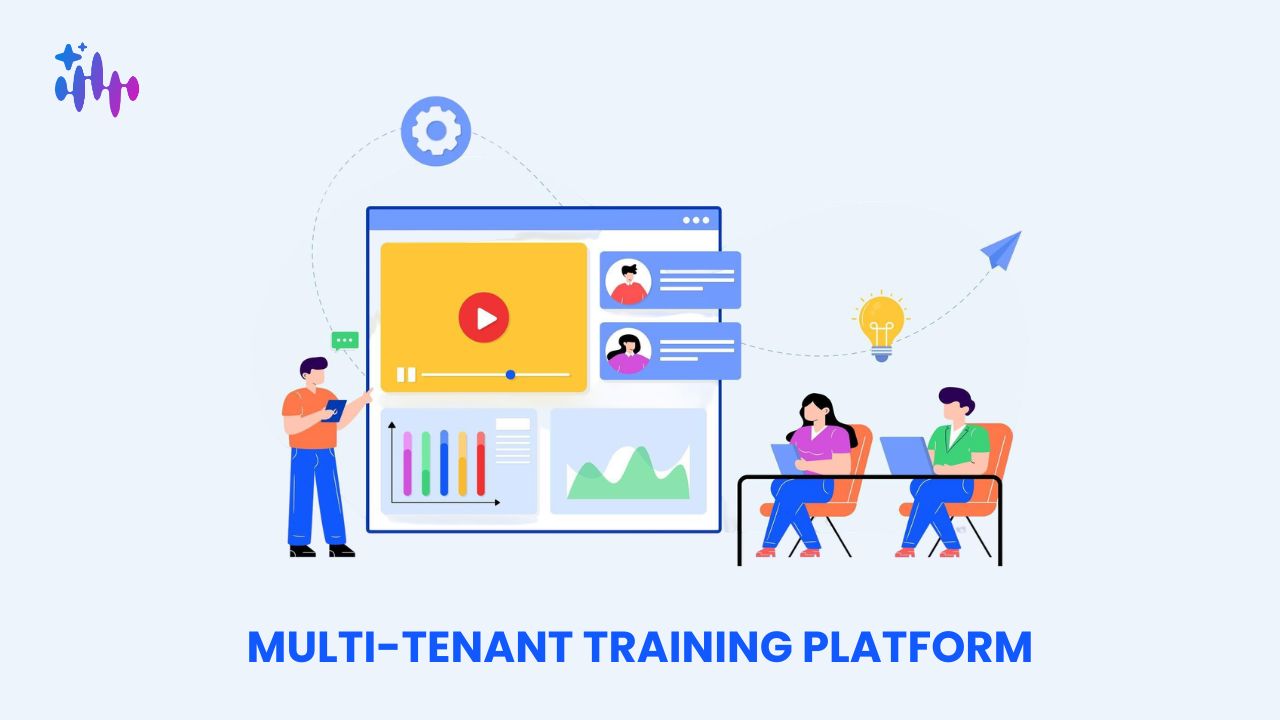
A multi-tenant training platform lets one provider serve many client organisations from shared infrastructure, and the commercial case is obvious. The question enterprise procurement will put to you is less comfortable: prove that Client A cannot see Client B’s learner records. Answering that convincingly requires understanding how separation is actually enforced, not just that portals look separate, and it applies whether you run your own stack or layer an AI Coach over an existing LMS.
Key Takeaways
- Separate portals are a presentation layer. Tenant isolation is enforced at the data layer, and procurement asks about the second.
- Three isolation models exist: separate database, separate schema, and row-level. Each has a different cost and risk profile.
- Cross-tenant administrative access is unavoidable and must be named, restricted, and logged.
- Shared course content across tenants is fine. Shared learner data is not.
- Write your answers once as a standing document rather than assembling them per deal.
🖥️ Sign In to Access Your Dashboard
The Three Isolation Models
Separate database per tenant: Each client’s data lives in its own database. Strongest isolation, highest operational cost, and slowest to provision a new client. Suits providers with a small number of large, security-sensitive accounts.
Separate schema per tenant: One database, separate schemas. A middle position that isolates well while keeping operations manageable. Provisioning is faster than separate databases.
Row-level isolation: All tenants share tables, with every row carrying a tenant identifier and every query filtered by it. Cheapest and fastest to provision. Isolation depends entirely on the filter being applied correctly on every query without exception, which is why enforcement must sit at the framework level rather than being left to individual queries.
| Model | Isolation strength | Provisioning speed | Operational cost | Typical fit |
| Separate database | Highest | Slow | High | Few large regulated clients |
| Separate schema | High | Moderate | Moderate | Mixed portfolio |
| Row-level | Adequate if enforced | Fast | Low | Many smaller clients |
None of these is wrong. What is wrong is not knowing which one you use, which happens more often than you would expect when the platform is someone else’s.
What Enterprise Procurement Actually Asks
Five questions, and they recur almost verbatim across security reviews.
How is tenant data separated? They want the model named, and they want to know what enforces it. “Each client has their own portal” describes the interface, not the isolation, and reviewers recognise the difference immediately.
Who can access data across tenants? Some of your staff must be able to, for support. The acceptable answer names the roles, limits them, and confirms that access is logged.
Can an export from one tenant include another’s data? They may ask you to demonstrate this rather than assert it.
What happens at contract end? Export format, export window, deletion timeline, and written confirmation of deletion.
Where is the data stored? Increasingly a blocker rather than a question in the GCC. Our guide to training data residency under PDPL sets out the regional requirements.
Cross-Tenant Access Is Not Optional
Providers sometimes claim no staff can see across tenants. It is rarely true, and reviewers know it, so the claim damages credibility.
Support requires it. If a client raises a ticket about a learner, someone has to look. The defensible position is not denying access but controlling it:
- Name the specific roles that hold cross-tenant access, and keep the number small.
- Log every cross-tenant read, with the accessing user, the tenant, and the reason.
- Make the log available to clients on request, which very few will ever use but all appreciate being offered.
- Review access lists quarterly and remove people who changed roles.
This is a straightforward control to implement and it converts an awkward question into a strong answer.
📄 Generate a Free PDF Sample Course in Your Cloned Voice
What Should Be Shared, and What Should Not
The distinction is between content and records.
Share course content: One library, scoped per tenant. Duplicating content per client means updating it repeatedly and watching versions drift, which is the same maintenance trap described in client-branded portals.
Never share learner records: Enrolments, progress, assessment results, and support conversations belong to one tenant only.
Be careful with aggregate analytics: Benchmarking a client against your wider learner base is commercially attractive and legally delicate. If you do it, the data must be genuinely aggregated and non-identifying, and your client contracts should say you do it. Discovering this in year two is a bad conversation.
Where Cross-Tenant Leakage Starts
To be clear about scope: tenant isolation is a property of your system of record. Vocaliv does not hold your learner records, and if your LMS separates tenants poorly, adding a layer above it does not fix that.
What it affects is the layer where cross-tenant leakage is easiest to introduce accidentally: automated learner support. An AI coach answering questions must be scoped to one tenant’s content and one learner’s history, and never draw on another client’s material when forming an answer. That scoping should be explicit rather than incidental, and it is worth asking any vendor how they enforce it.
For a provider serving six enterprise clients
| Metric | Before | After |
| Security review response time | 2 to 3 weeks per deal | Standing document |
| Cross-tenant access logged | No | All reads |
| Course updates per content change | 6 | 1 |
| Deals stalled on security questions | 2 of 6 | 0 |
Preparing for a Security Review
- Confirm which isolation model your platform actually uses, and get it in writing from your vendor if it is not yours.
- Name the roles with cross-tenant access and reduce the list.
- Turn on logging for cross-tenant reads and review the log quarterly.
- Test an export from one tenant and confirm no foreign records appear.
- Write the five procurement answers once and attach them to every proposal.
- Check your client contracts before using any cross-client aggregate analytics.
Frequently Asked Questions
A platform where one provider serves multiple client organisations from shared infrastructure, with each client’s data logically separated. Separate branded portals are the presentation layer. Tenant isolation at the data layer is what actually prevents one client seeing another’s learner records.
Through one of three models: separate database per tenant, separate schema per tenant, or row-level isolation where every row carries a tenant identifier and every query is filtered. Row-level is cheapest but depends on enforcement at the framework level rather than per query.
Some must, for support, and claiming otherwise damages credibility in a security review. The defensible position names the specific roles holding cross-tenant access, keeps the number small, logs every cross-tenant read with a reason, and reviews the access list quarterly.
Five recurring questions: how tenants are separated and what enforces it, who can access across tenants, whether an export can include another client’s data, what happens to data at contract end, and where the data is stored. Prepare written answers in advance.
Yes, and you should. One library scoped per tenant avoids duplicating content and watching versions drift. Learner records, however, must never be shared. Aggregate cross-client benchmarking is commercially attractive but requires genuinely non-identifying data and contract language permitting it.
If a security review has stalled a deal in the last year, the fix is usually a standing document rather than a platform change. Write it once.